
In today's ever-evolving healthcare landscape, the demand for skilled healthcare workers is steadily rising, especially in rural and semi-urban areas where access to primary care is often limited. One increasingly popular pathway into healthcare services—especially in primary care—is the CMS and ED Course, or Community Medical Services and Essential Drugs program. But the pressing question remains: Can you really work in primary care with a CMS and ED course?
Let’s explore the scope, significance, and professional opportunities associated with this course, including the value of a B.Voc in CMS ED, how vocational training partners and skill development training partners are playing a vital role, and how recognized certifications from UGC-approved centres and institutions like Glocal University Vocational can empower aspiring healthcare professionals.
Understanding the CMS and ED Course
The CMS ED Course is a vocational-level program designed to train individuals in primary healthcare services, particularly in underserved or rural areas. It covers the fundamentals of community medicine, health awareness, essential drug usage, basic diagnostics, and first aid, enabling graduates to assist doctors or even work independently under specific regulatory norms.
This vocational course in CMS ED bridges the gap between formal medical degrees and community healthcare services. It is not intended to replace MBBS or nursing qualifications but offers a practical alternative for those passionate about serving in primary healthcare roles, especially where medical personnel are scarce.
What Does the B.Voc in CMS ED Offer?
A Bachelor of Vocation (B.Voc) in CMS ED goes a step further by integrating skill-based training with academic knowledge. It is a UGC-approved vocational degree designed for students who want a career in community medical services but prefer a flexible, career-oriented curriculum. Unlike traditional degrees, the B.Voc focuses more on hands-on training and employability skills.
Students enrolled in the B.Voc in CMS ED program receive comprehensive knowledge in:
Community health and disease prevention
Basic pharmacology and use of essential drugs
Clinical diagnostics and emergency response
Health education and sanitation practices
Primary care protocol and patient handling
The B.Voc in CMS ED is ideal for those who want to work in primary care clinics, health camps, or rural healthcare centers. It also opens doors for further certifications or lateral entry into higher education in health sciences.
What is a CMS ED Certificate and Why is it Valuable?
A CMS ED Certificate validates that the holder has undergone professional training in delivering basic healthcare services and managing essential drugs under community medical protocols. It is particularly important in rural India, where doctors are often not available, and certified CMS ED professionals step in to offer preliminary medical advice and assistance.
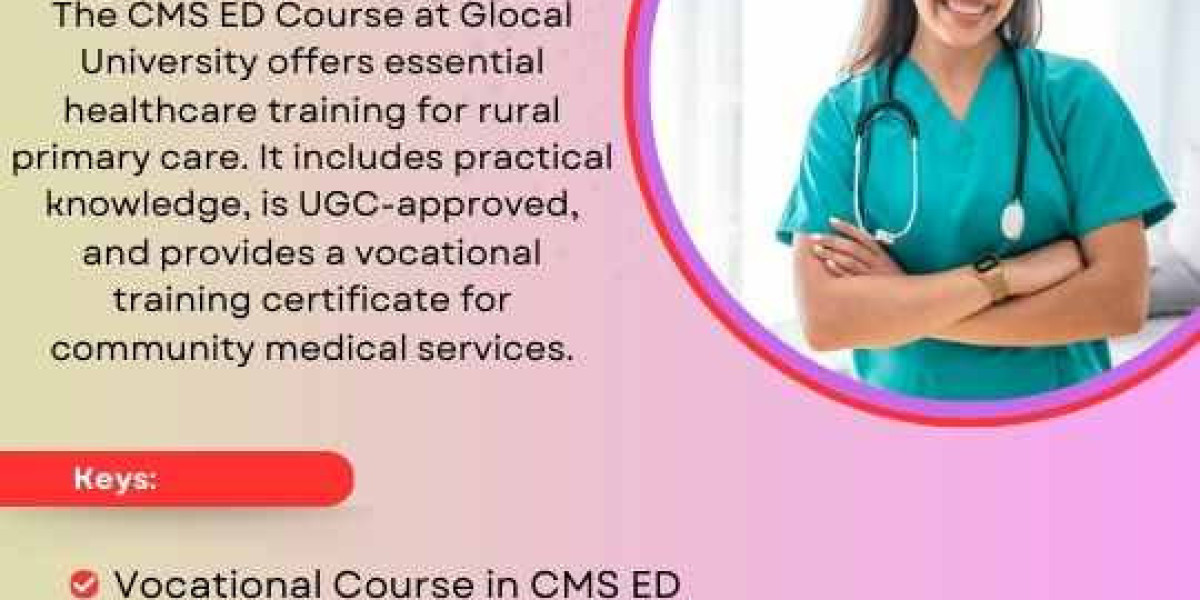
When obtained from a UGC-approved centre, the CMS ED Certificate ensures that the curriculum meets national education standards and increases the credibility of the holder. For example, institutions like Glocal University Vocational offer CMS ED courses that are compliant with national skill development standards and UGC recognition, making graduates more employable in both public and private healthcare sectors.
Role of Vocational Training and Skill Development Partners
The success of programs like the CMS ED Course and B.Voc in CMS ED depends heavily on vocational training partners and skill development training partners who provide the necessary infrastructure, faculty, and hands-on training.
These training partners, often accredited by regulatory bodies or in collaboration with UGC-approved centres, ensure:
Practical experience through labs and fieldwork
Updated curriculum aligned with healthcare standards
Industry interaction and real-world exposure
Skill-based certification under national frameworks
Placement assistance or career counselling
Being associated with reputed vocational training partners gives students access to a structured pathway to employment, especially in the healthcare sector.
How Glocal University Vocational Supports CMS ED Aspirants
Glocal University Vocational is a leading institution that offers skill-based degree programs including CMS and ED courses. The university focuses on empowering students with both academic learning and practical skillsets, ensuring that graduates are work-ready upon completion of their program.
Some of the highlights of CMS ED courses at Glocal University Vocational include:
UGC-recognized curriculum
Blended learning with on-field exposure
Certification aligned with healthcare needs
Strong network of healthcare partners for internship or job placement
Opportunity to pursue further education or specialization
For students from underserved regions or those seeking affordable healthcare education, Glocal University offers a credible and sustainable path into primary care.
Can You Work in Primary Care After Completing a CMS and ED Course?
Yes, you can. While the scope may vary depending on state regulations and specific healthcare setups, CMS ED graduates are generally allowed to work in the following roles:
Community Health Workers
Primary Care Assistants
First-Aid and Emergency Response Executives
Health Education Officers
Dispensary or Clinic Operators under supervision
Support staff in rural healthcare centers
Volunteers in NGO-led health camps and mobile medical units
In many rural or low-resource settings, CMS ED professionals are the first point of contact for medical aid. Their presence ensures timely health intervention, referral, and prevention efforts. With the rise of telemedicine and government-backed rural health missions, CMS ED certificate holders are finding greater recognition and employment opportunities than ever before.
The Power of a Vocational Training Certificate
A vocational training certificate in CMS ED not only validates your training but also boosts your confidence to serve in the field of healthcare. It reflects your commitment to public welfare and your readiness to take on medical responsibilities at the grassroots level.
When backed by a UGC-approved institution and a recognized skill development training partner, this certificate can pave the way to a stable and rewarding career in the healthcare industry—especially in areas where medical professionals are in short supply.
Conclusion
If you're passionate about making a difference in people’s lives through healthcare and are looking for a cost-effective, accessible, and impactful career path, the CMS and ED course could be your gateway. Whether through a B.Voc in CMS ED or a standalone CMS ED Certificate, you can become a vital part of the primary care ecosystem—offering services where they are needed the most.
Institutions like Glocal University Vocational, along with vocational training partners and skill development training partners, are making this dream a reality by offering quality education, practical training, and nationally recognized certifications.
In short: Yes, you can work in primary care with a CMS and ED course—especially if you choose the right training partner and certification path.